Why Projects Stay on Track – Until They’re Not


Why Projects Stay on Track – Until They’re Not
Why Project Status Says "On Track," Right Up Until It Isn't
A project can show green status for months and still miss its delivery date by weeks, without anyone lying on a status report. This happens because most status reporting tracks whether individual tasks are meeting their own deadlines, not whether the specific work that determines the project's finish date is actually progressing. A team can absorb delays quietly — working weekends, shifting lower-priority work, calling in favors — and every affected task still reports "on track," because the report only asks whether a date was hit, not what it cost to hit it or whether the same recovery is available next time.
The Mechanism, Not the Blame
When a project status report shows green, it's usually answering one narrow question, repeated across every task: did this task finish by its planned date, or is it still on pace to? That question has a yes-or-no answer, and most of the time, for most tasks, the answer is yes — because people who own individual deadlines have real incentives to protect them. If a task is at risk, the person responsible for it often finds a way to absorb the risk locally before it becomes visible: they work extra hours, ask a colleague for help, or delay something else they're responsible for that doesn't have as hard a deadline.
None of these responses are dishonest. Each one is a reasonable, individually rational decision by someone trying to meet a commitment. But a status system built only to check "did this task hit its date" has no way to see the difference between a task that finished on time because nothing went wrong, and one that finished on time because someone spent a weekend quietly fixing a problem that would otherwise have delayed it. Both report the same color.
The pattern repeats, task after task, often for months. Then a delay surfaces that's too large for any one person to absorb locally — usually because several small, invisible recoveries all drew from the same limited well of goodwill, overtime, or slack, and that well runs dry at the same time. When that happens, the project's status can move from "on track" to "we're going to miss the date by seven weeks" with very little warning, because the warning signs were never in a format the reporting system was built to capture.
This isn't a rare or isolated pattern. Independent industry research on project performance — including long-running studies of large capital and technology projects — has repeatedly found that a meaningful share of projects reported as on track continue to be reported that way for extended periods before a significant delay or overrun becomes visible, rather than showing a steady, gradual decline that would be easy to catch early. The specific figures vary across studies, timeframes, and industries, but the underlying finding is consistent: status reporting built around individual task dates tends to understate risk until relatively late in a project's life, which is precisely the mechanism described here.
Why This Isn't a Discipline Problem
It's tempting to read this pattern as a communication failure — people should have spoken up sooner. But most people did exactly what their role and incentives told them to do: protect their own commitment, and only escalate once local options were exhausted. Asking individuals to volunteer "I hit my date, but only because I quietly absorbed a problem" runs against how most organizations evaluate performance. Meeting a deadline is treated as success regardless of what it took; missing one is treated as a problem regardless of the reason. Given that framing, absorbing risk quietly and reporting green is the rational choice for almost anyone in that position — not a lapse in honesty.
This is why simply asking teams to "surface risk earlier" rarely works on its own. The people closest to the risk are already responding to the incentives the reporting system creates. The fix has to change what the system asks and rewards, not just remind people to speak up.
What Most Status Reporting Actually Measures
Most project status systems are built around two things: whether a task has started or finished, and whether that happened on or near its planned date. Rolled up across a project, this produces an overall status color — commonly green, yellow, or red — based on how many tasks are currently meeting their dates.
This works reasonably well when every task matters equally to the project's finish date, and when tasks that are running late are also the ones that actually determine when the project completes. Neither assumption holds in most real projects. A large project can easily have hundreds of open tasks, and typically only a small subset of them actually determine how quickly the project as a whole can finish — the rest have some amount of natural slack, meaning they could run late without changing the finish date at all.
A status system that treats every task's on-time performance as equally important will show the same green light whether the tasks currently at risk are the ones that matter or the ones that don't. This means a genuinely dangerous delay — on a task with no slack, feeding directly into the completion date — can look identical, on a dashboard, to a delay on a task with weeks of slack to spare, right up until the dangerous one actually causes a miss.
What a Different Kind of Status Signal Looks Like
An alternative to tracking every task's individual date is to track how much of a project's built-in schedule margin has been used, relative to how much of the truly critical work has been completed. Instead of asking "is this task on schedule," this approach asks a portfolio-level question: given how much of the schedule buffer we've already consumed, and how far through the critical work we actually are, is our rate of consumption sustainable, or are we burning margin faster than our progress justifies?
This kind of signal can indicate rising risk well before any individual task is reported late, because it's measuring a rate — buffer consumed versus progress made — rather than a binary per-task check. A project can be consuming its margin unsustainably fast while every individual task still shows "on track," simply because the margin was never allocated to individual tasks in a way any single status report would catch.
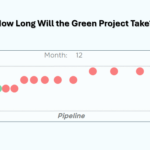
Software built around this approach, such as Fusion Online, typically visualizes this relationship as a fever chart, and calculates a per-task criticality score reflecting how close each specific task is to threatening the project's completion date — which lets a small number of genuinely important tasks get attention, instead of treating a status update on any of hundreds of open tasks as equally informative. This approach to scheduling is known as critical chain project management, and it differs from traditional critical path scheduling specifically in how it accounts for shared, limited resources — see Critical Path vs. Critical Chain for the underlying mechanics.
Common Questions
- Why does a project's status look fine until right before it's late?
- Most status reporting checks whether individual tasks are meeting their own planned dates, not whether the specific work determining the project's overall finish date is progressing fast enough. Teams can absorb small delays quietly for months without any task ever reporting behind schedule, until several of those quiet recoveries run out of room at the same time.
- Is a team hiding problems if status stays green during a hidden delay?
- Not necessarily, and usually not. Individuals responding to at-risk tasks by working extra hours or reallocating their own time are making reasonable local decisions, not concealing information. The reporting system typically has no field for "on time, but only because of an unplanned recovery effort," so that information has nowhere to go even when someone would be willing to share it.
- How can leaders get earlier warning that a project is at risk?
- Tracking the rate at which a project's schedule margin (buffer) is being consumed, relative to how much of the truly critical work is complete, can surface risk earlier than task-by-task status checks — because it measures a trend across the whole project rather than a yes-or-no check on any single task.
- Does this mean traditional status reports are useless?
- No. Task-level status is still useful for coordination and day-to-day management. The issue is relying on it as the primary signal of overall project health, since it can't distinguish a delay on a task with no schedule impact from a delay on a task that will directly cause the project to miss its date.
The Short Answer
Projects rarely go from healthy to late overnight. They go from a string of individually reasonable, invisible recoveries to a point where those recoveries run out at the same time — and most status reporting isn't built to see that coming, because it checks whether tasks hit their dates, not whether the project's real schedule margin is being spent faster than its progress justifies. Recognizing this pattern doesn't require overhauling an organization's entire reporting approach immediately, or committing to a full methodology change to see the benefit — see Do You Have to Fully Adopt Critical Chain to Get Value From Fusion Online? for how Fusion Online is specifically built to let the underlying scheduling and visibility improvements be adopted incrementally.